Farmer-led · Alchemist
Medium armor balances offense and defense and has a faster base march pace. Your city specialty improves healing, and the Library develops economy and care.
The gameplay guide
Follow the decisions that turn residents into workers, resources into opportunity, and a settlement into an army’s home. These are genuine captures from the desktop Alpha.
Settle · Your starting point
You arrive with a Citadel, Houses, Tool Workshop, and Storage already standing. Residents are idle, your first profession tools are ready, and Food and Materials give you room to begin. Weapons must be produced by your Blacksmiths.
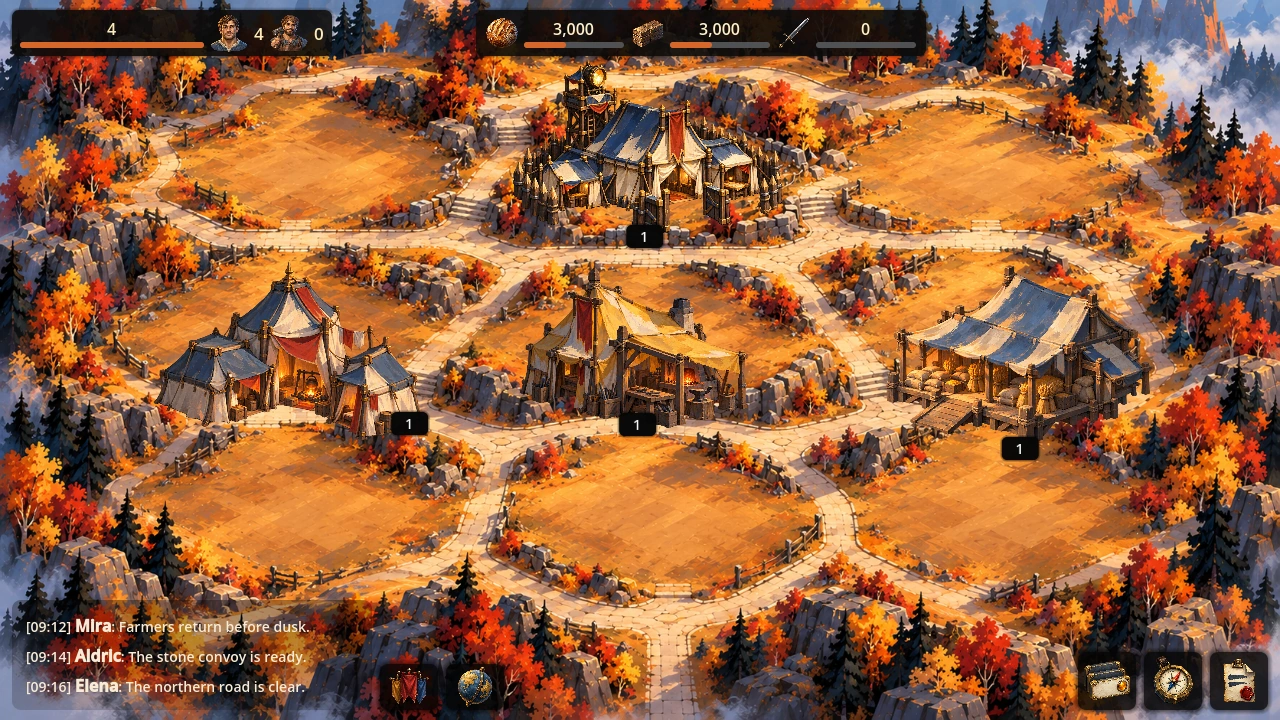
Select a building to open its detail panel. The Building tab explains its purpose and upgrades; its other tab holds the work you can do there. The top of the screen shows residents, resources, and your city’s completed development time.
Give people a purpose
In Houses, open Workers. Farmers produce Food, Engineers produce Materials, and Blacksmiths produce Weapons. Use the plus control to order training when an idle resident and the right unused tool are available.
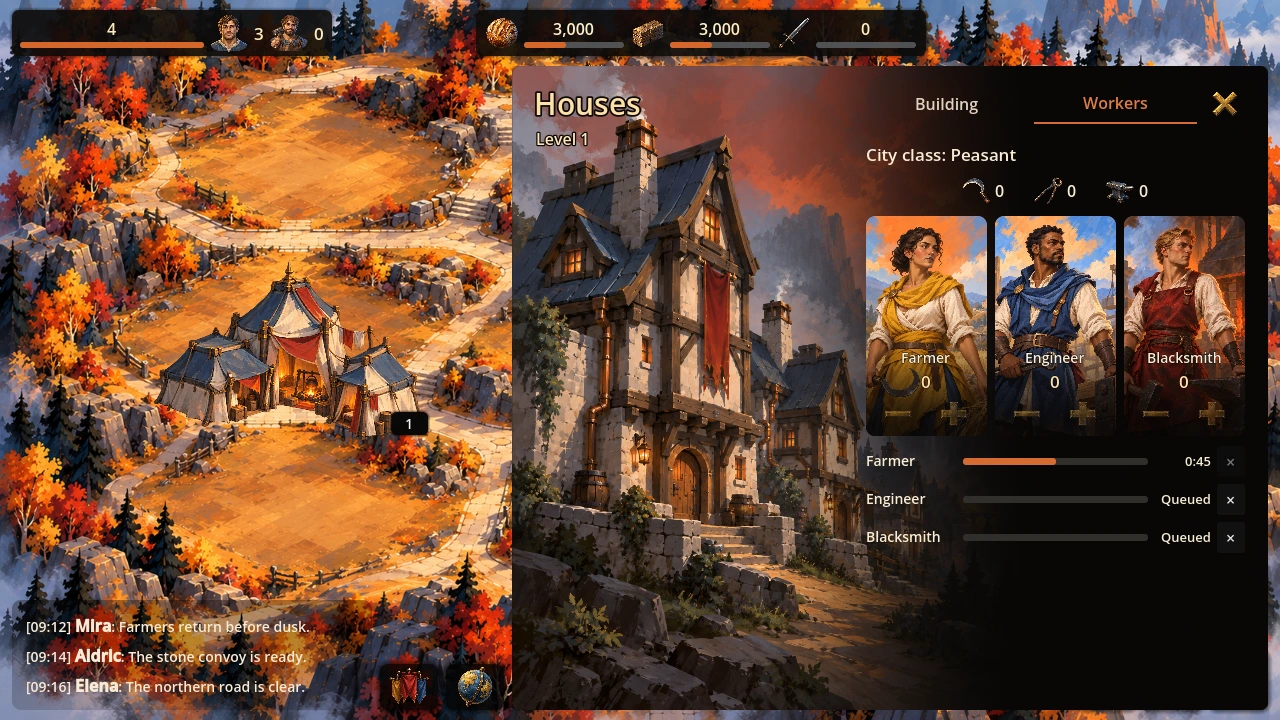
A tool is reserved as soon as training is ordered. Workers train in sequence; completed workers start contributing to their resource.
Balanced professions give your city a steadier start. A focused workforce produces its chosen resource more strongly, but will need help covering the others.
Cancelling waiting training returns its tool. Cancelling active training returns the resident but uses up the tool. Unassigning a trained worker also leaves the tool spent. Safeguards protect your route back to each resource when tools are scarce.
The Workshop keeps growth moving
Open the Tool Workshop’s Crafting tab. Choose the tool for the profession you want to grow next. Every recipe uses Food, Materials, and Weapons, which makes your first Blacksmith especially useful.
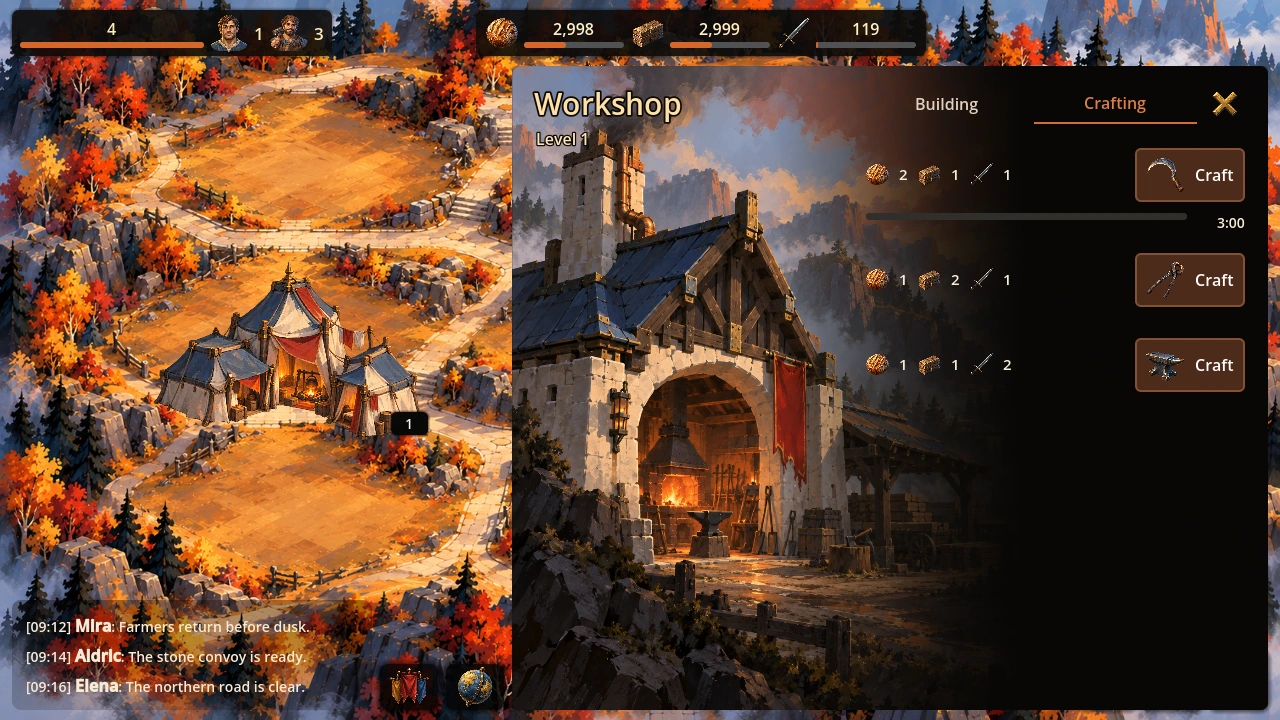
Tools are crafted individually in a queue. Each order is paid in full when you place it. An order you cannot afford is rejected; a waiting tool order can be cancelled for a full refund. Active tool crafting currently continues to completion.
Expand · Open the next possibility
Raise the Citadel to lift the ceiling on other buildings. Expand Houses to make room for more residents, who arrive gradually while space is available. More residents give you more choices for your workforce.
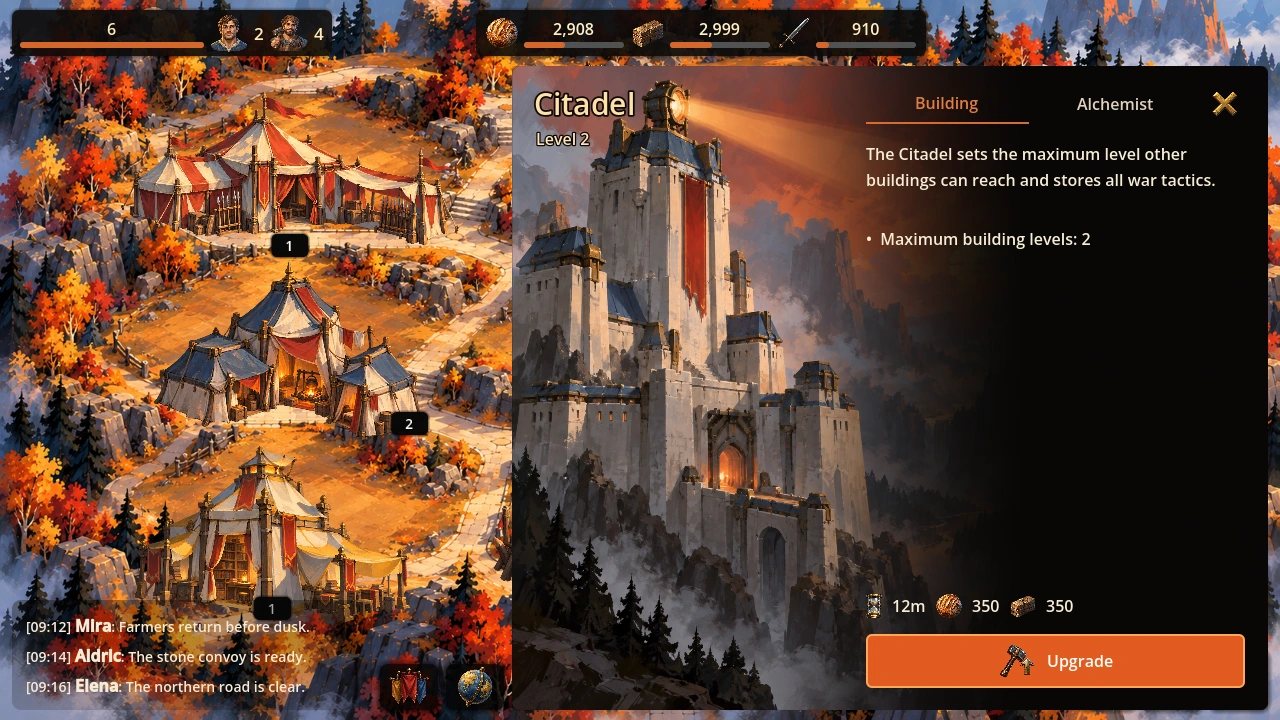
Establish your trained workforce to reveal the Barracks construction site. Recruit your first soldier to reveal the Hospital. Complete the Hospital to open Library, Fortification, and Siege construction.
New buildings and upgrades use an available builder and prepay Food plus Materials. Citadel progress and the current era both limit how high a building can grow.
Later eras bring another builder automatically, giving your city more room to construct in parallel. Buildings progress from tents and thatch to timber, stone, and working steam machinery.
City rank records the actual active time spent on completed construction and research. Work still in progress and cancelled jobs add nothing.
Food · Materials · Weapons
Food and Materials build the city. Food and Weapons recruit soldiers. Materials and Weapons fund research. Tools connect all of them back to your workforce.
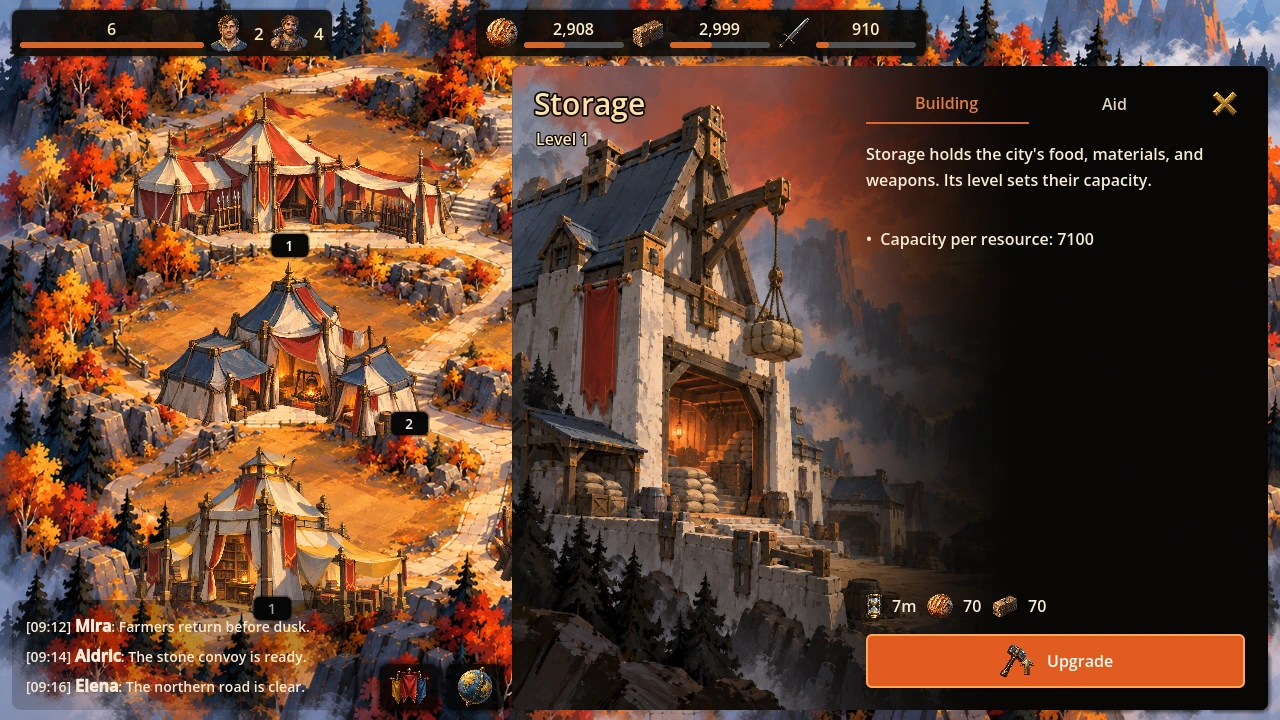
Storage has a separate bin for each resource. A full bin pauses only its own production. The surplus does not automatically move to guild storage, so spend, expand, or plan a transfer as the cooperative game develops.
Storage’s Aid tab previews resource requests. Live delivery to a guild Treasurer and shared bank transfers belong to the planned multiplayer game.
Your workforce becomes your identity
You begin as a Peasant. Once your workforce is established, the profession with the most trained workers determines your city’s class. The change happens when training completes. The Citadel’s Class tab shows your current direction and links back to the matching worker controls.
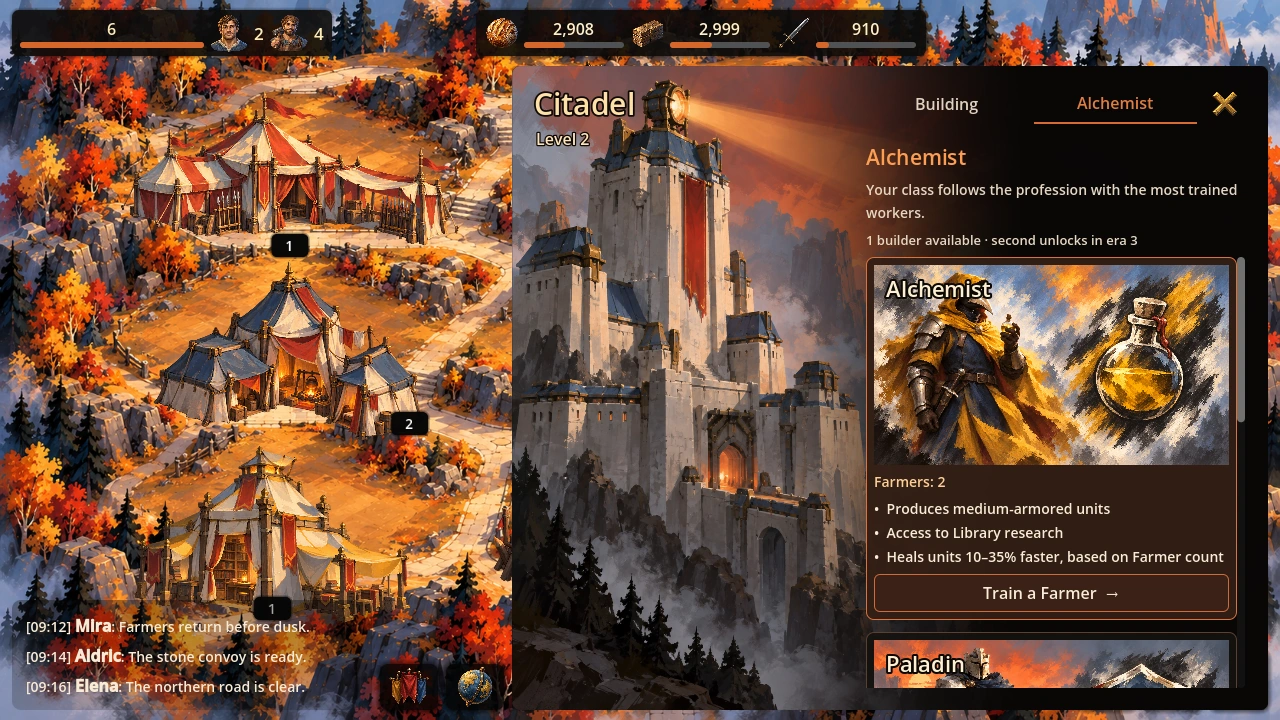
Medium armor balances offense and defense and has a faster base march pace. Your city specialty improves healing, and the Library develops economy and care.
Heavy armor brings stronger defense with weaker offense and a slower base march pace. Your specialty improves construction and research; Fortification develops protection.
Light armor brings stronger offense with weaker defense and a middle base march pace. Your specialty improves recruitment; Siege develops attack.
You can change your workforce and move into another class. Completed research stays with the city, so discoveries made along an earlier path remain valuable.
In the planned war game, Alchemists sustain allied forces, Paladins help protect them, and Berserkers press the attack. Their class passives grow stronger in a Commander’s rally; those war effects are still in development.
Muster · Build the force you need
At the Barracks, open Units and choose Infantry, Archers, or Cavalry. Your active class determines the armor available for new recruits. Ordinary soldiers use Food and Weapons without taking residents away from city work.
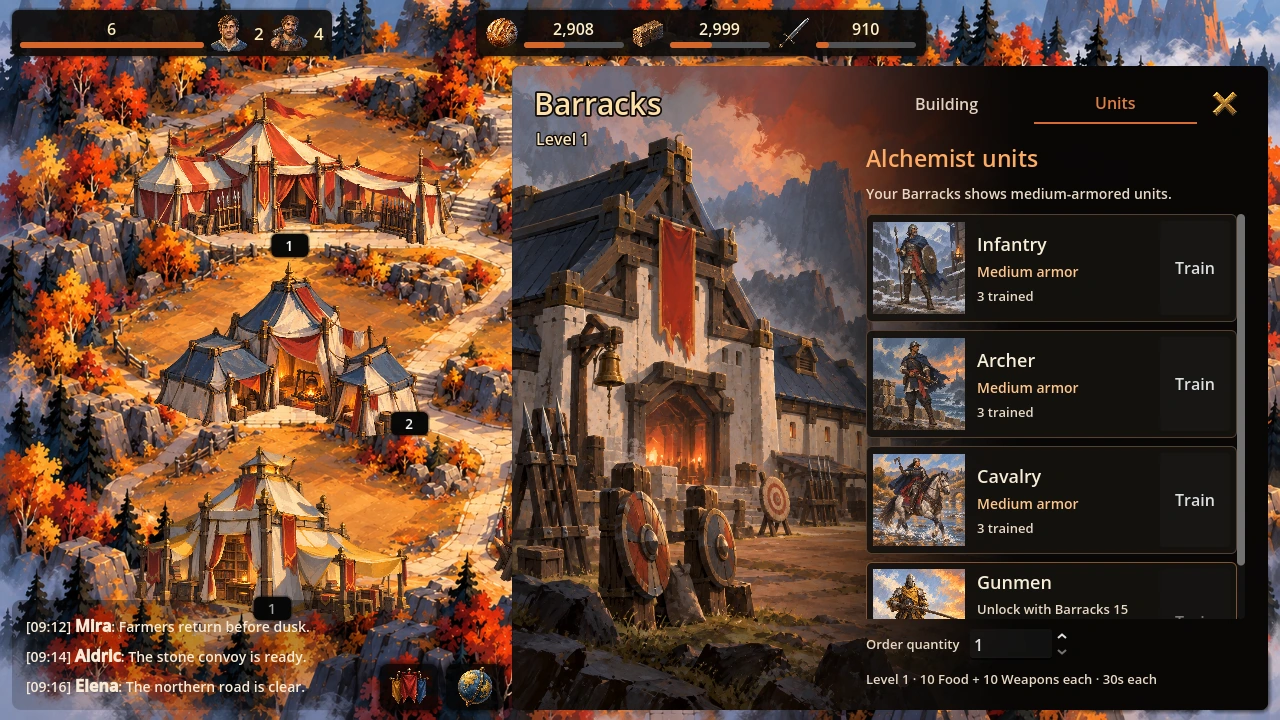
Recruitment trains soldiers in sequence. A quantity order pays for the entire group up front and fixes its troop kind, armor, and Barracks level when ordered. Improving the Barracks produces stronger new soldiers; older soldiers keep the level they were trained at.

Stronger against Archers
Weaker against Infantry. A favorable target matters as much as the force you bring.

Stronger against Infantry
Weaker against Cavalry. Keep the whole counter cycle in mind when composing an army.

Stronger against Cavalry
Weaker against Archers. A mixed force gives you more ways to answer an opponent.
Terrain is planned to make Attack and Defense stronger or weaker depending on the troops and armor you bring. Terrain does not change march speed; armor, class passives, and travel research have their own movement rules.
Fortify · Preserve your strength
Open the Hospital’s Care tab to inspect wounded troops and their recovery. Hospital capacity is shared across your city’s expeditions. Better care gives more wounded soldiers a chance to return.
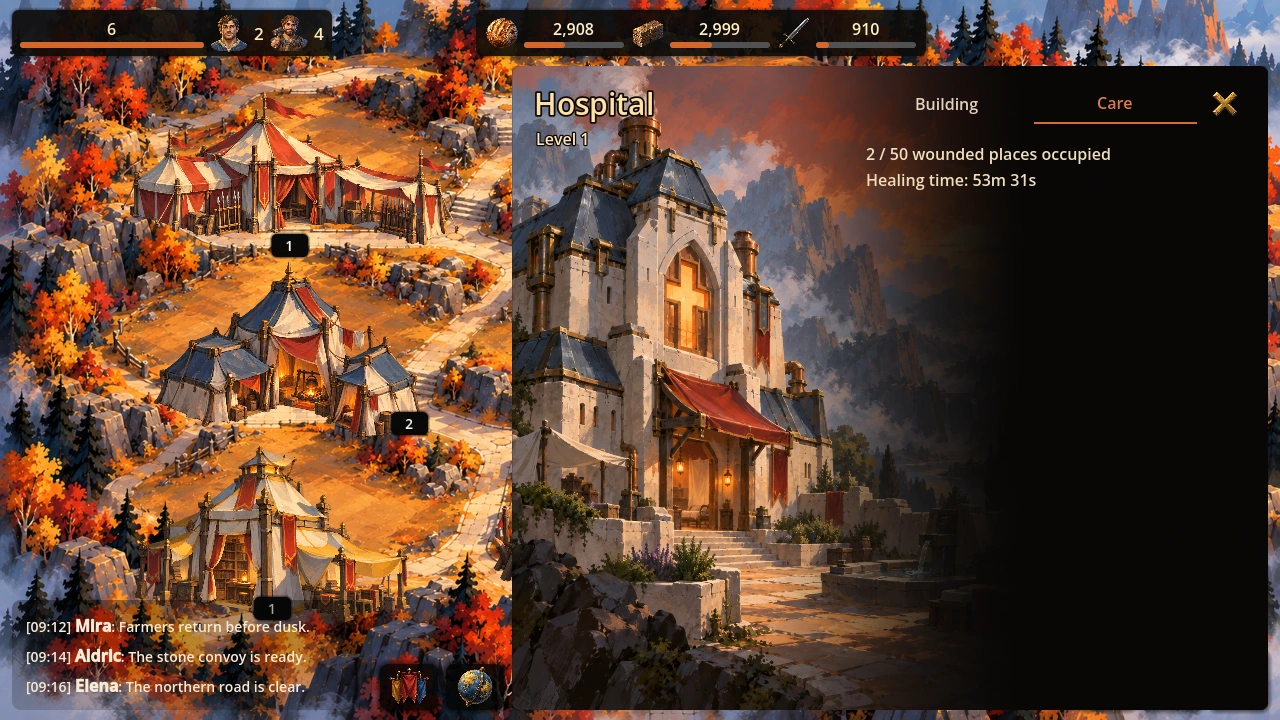
In the planned battle flow, direct battle deaths are permanent. Wounded soldiers are admitted after battle; those beyond available Hospital capacity become further losses. Alchemist research improves capacity and healing. Extra care for allied wounded applies only to a Commander-created rally.
Discoveries make your choices stronger
Library, Fortification, and Siege each hold a class-aligned research path. You can queue your active class’s path, spending Materials and Weapons up front. Later eras open deeper discoveries while earlier work remains available.
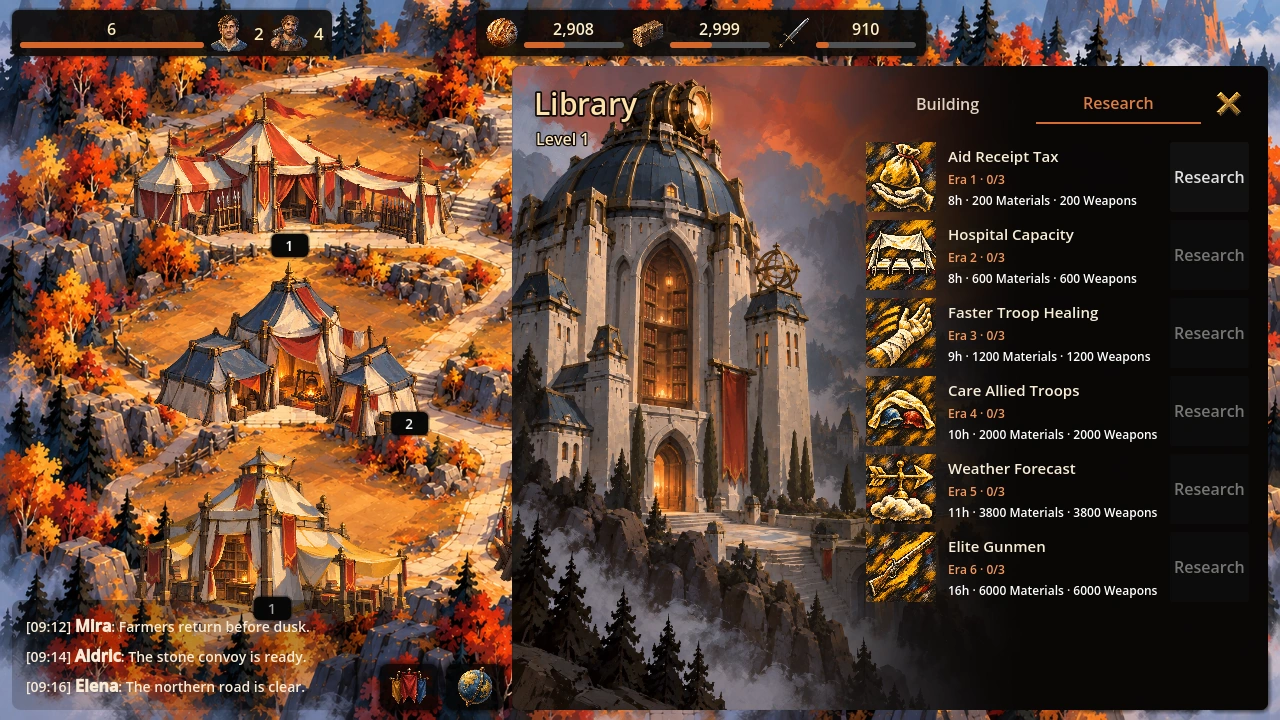
Better Aid receipts, more Hospital capacity, faster recovery, rally care for allies, planned weather forecasts, and eventually Gunmen.
Stronger action against rebel villages, reduced incoming damage, better stronghold construction and defense marches, and eventually Cannon Men. Its later armor-related benefit is still being refined.
Stronger village attacks, harder-hitting troops, faster recruitment, stronger stronghold assaults and attack marches, and eventually Catapults.
Research uses a shared queue. Matching professions help their research progress faster. Completing an era’s full research tier on a path also improves construction and research timing across the city; completing another path in that era does not repeat that shared milestone.
Changing class preserves finished discoveries. A research job already running continues; a waiting job on the previous path waits for that class to return. Research that helps allied forces activates only in a Commander’s rally.
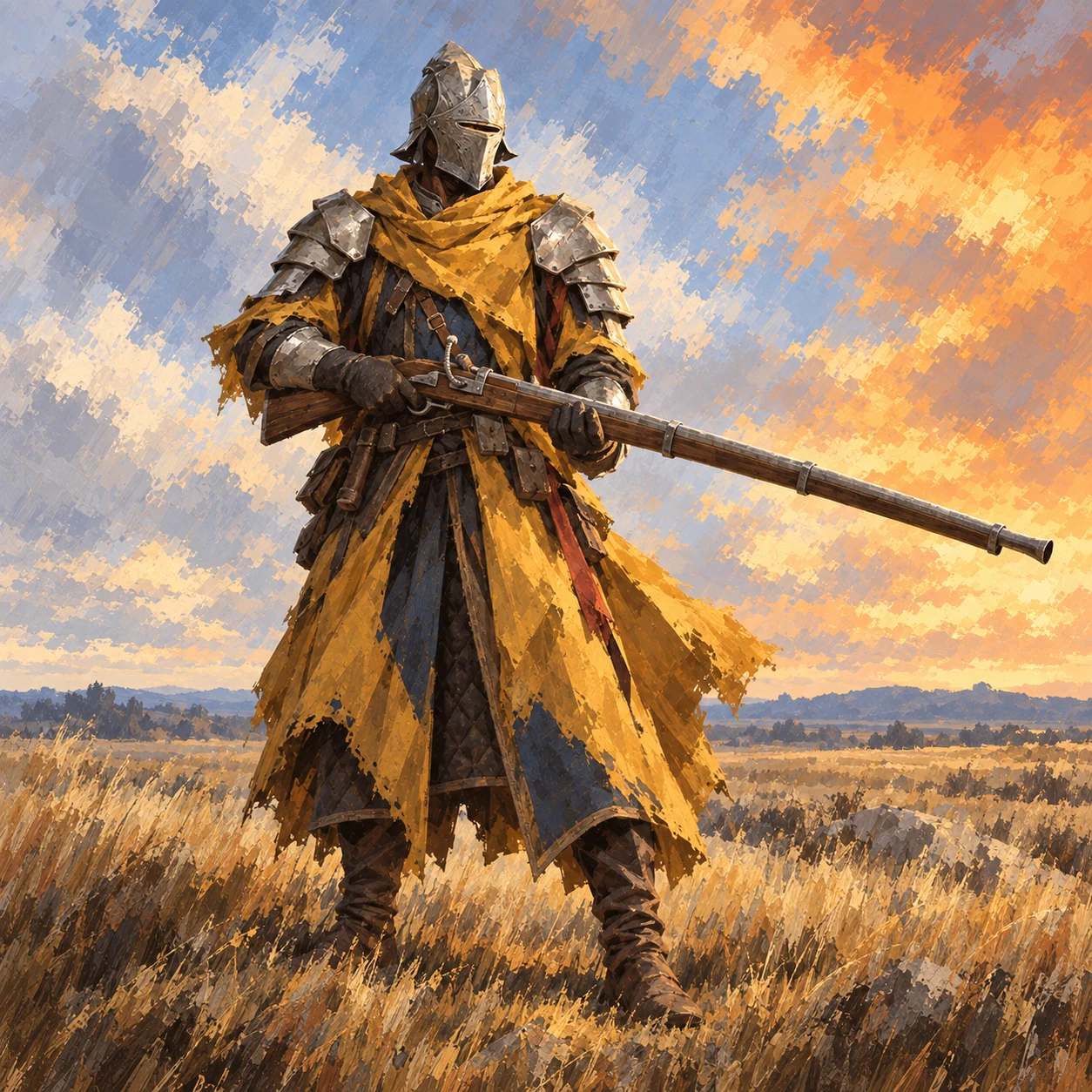
The Alchemist’s elite firearm troops, designed for stronger open-field fighting.
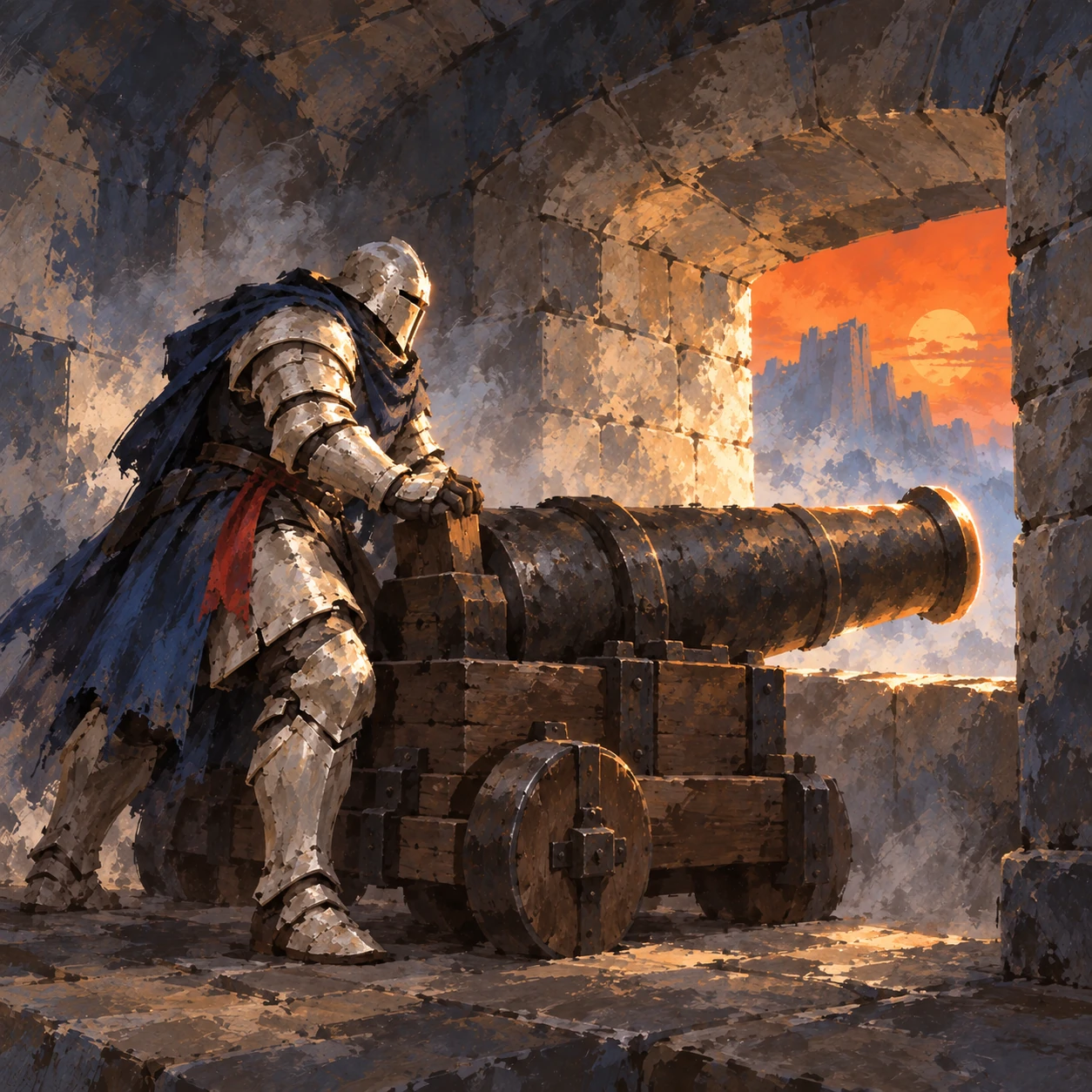
The Paladin’s stronghold defenders. Their strength is protection rather than open-field damage.
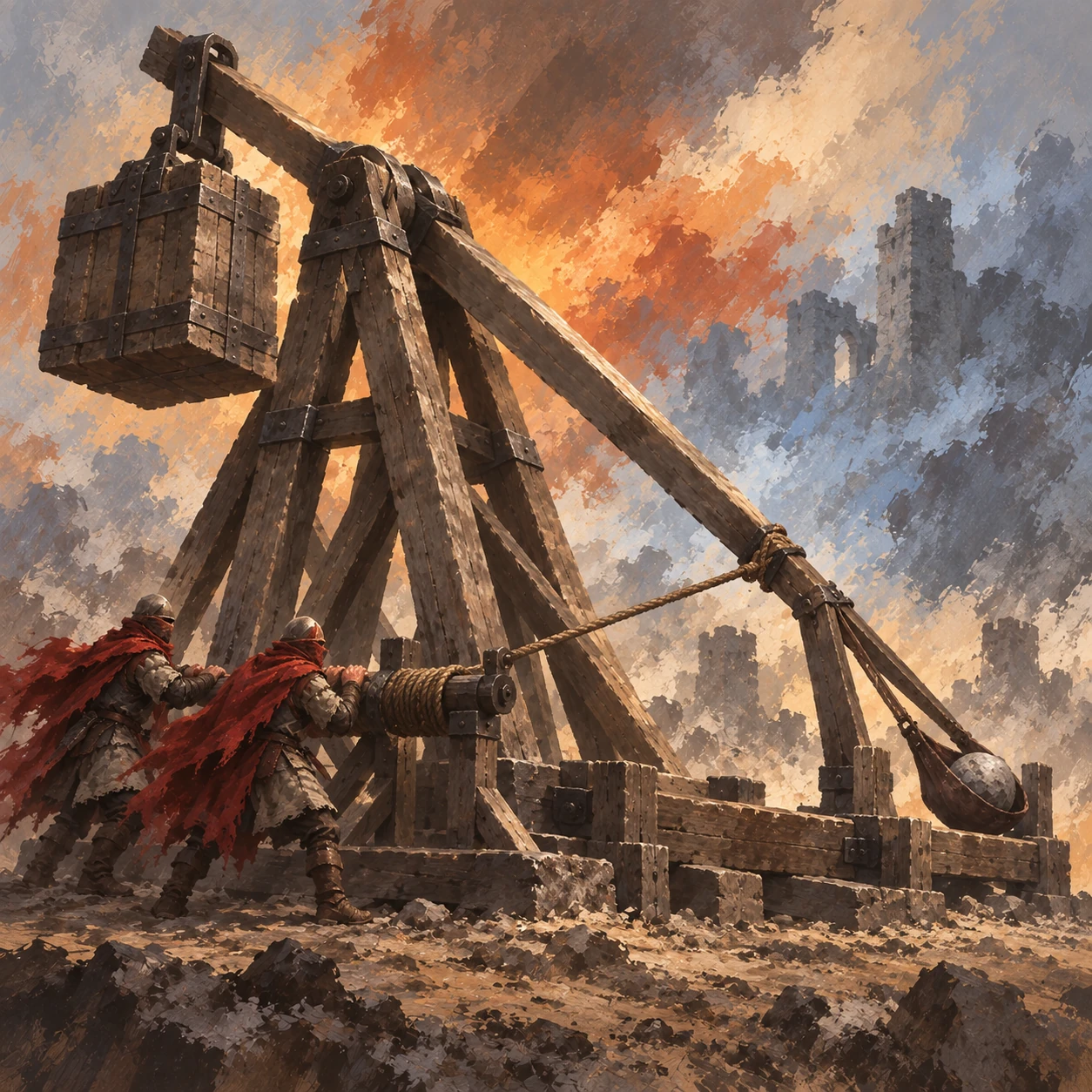
The Berserker’s stronghold attackers. Powerful siege specialists with no open-field attack.
Elite recruitment requires the final era, a fully developed Barracks, the matching active class, and the completed research path. Recruitment is in the Alpha; elite performance in live battles is still being tuned.
Plan · Let a good decision keep working
The Queue button brings Building, Training, Research, and Workforce work into one place. Check what is active, what is waiting, and which commitment you want to keep.
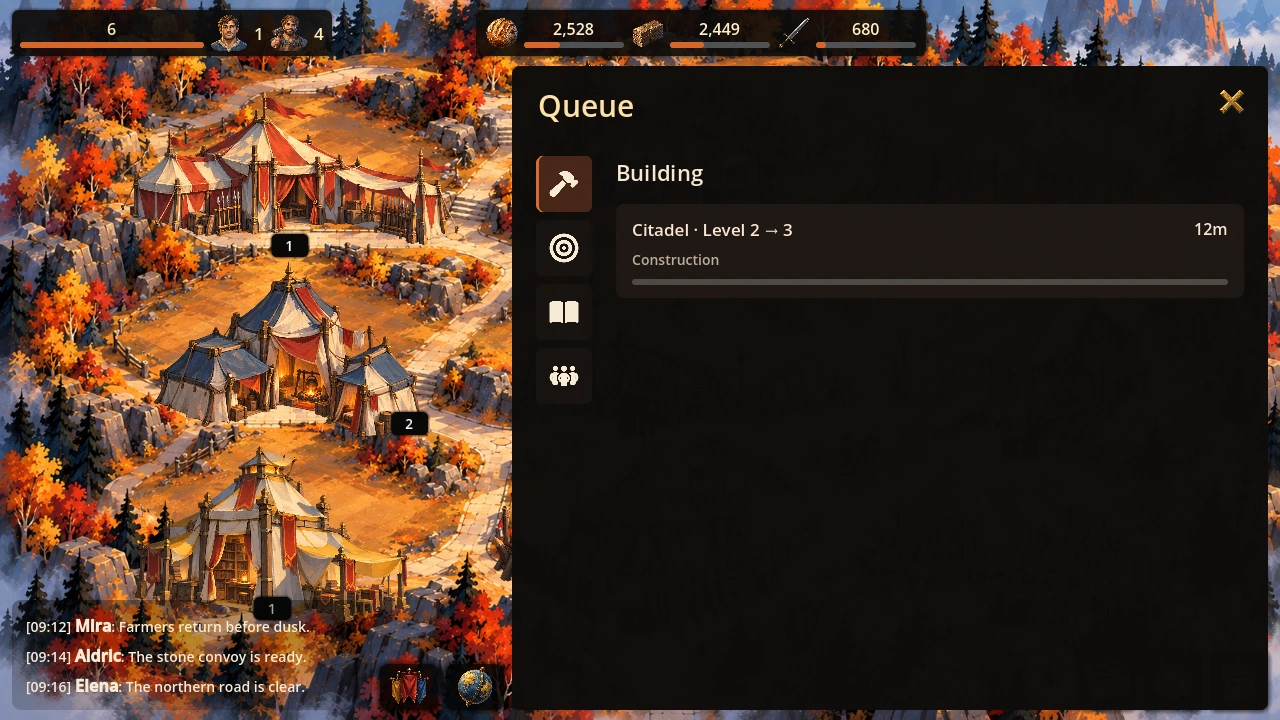
A builder serves construction. Workers train in sequence, tools craft in sequence, soldiers recruit in sequence, and research uses its own shared queue. Preparing the next paid order lets a useful plan keep moving during your city session.
The studio’s goal is a game that respects a full schedule. The Alpha is still testing pacing and does not yet have an authoritative seasonal world clock.
Beyond your walls
The guild hub shows your city’s class, resources, roster, and a preview of the offices that will connect cities. The World view lets you inspect the expanding terrain idea. Both are local previews; shared guild actions, troop dispatch, live chat, and world battles are not available yet.
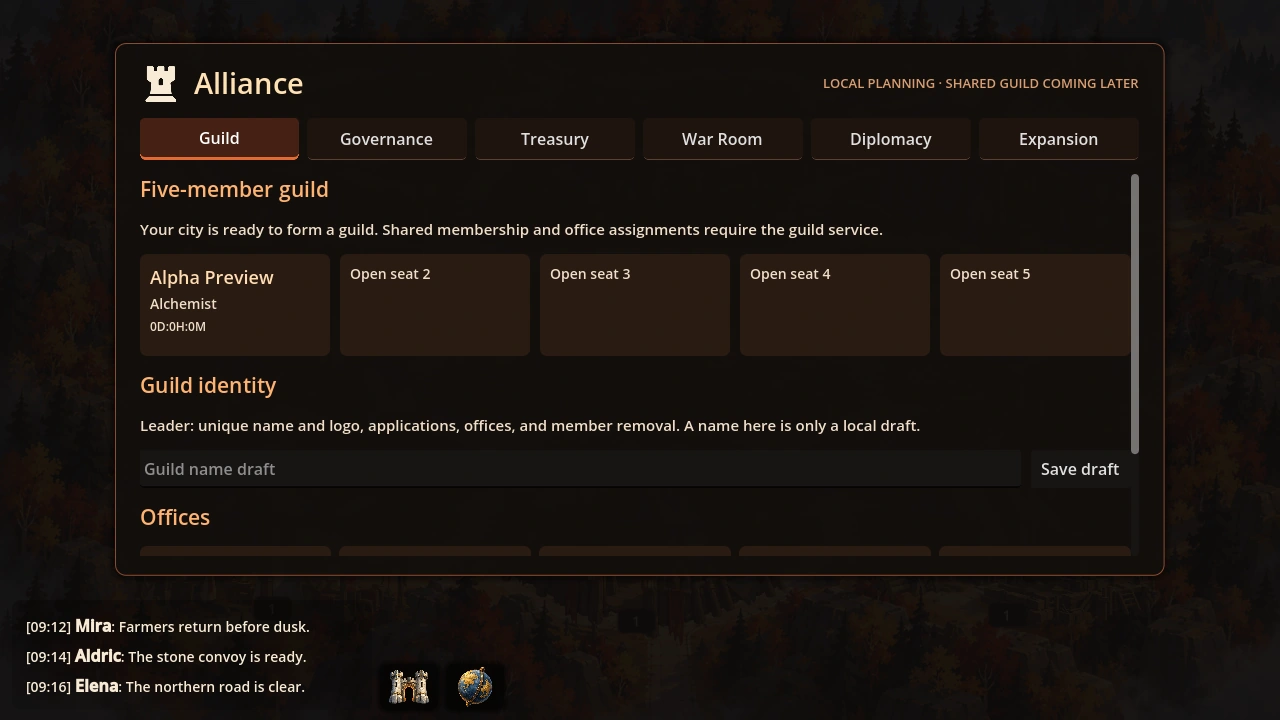
Discover guild offices, shared resources, frontier expansion, strongholds, and the road to the final war.
Explore guilds & the world